|
Back to Blog
 It’s not often you come across a CV as jam-packed as that of Peter Oakes, the founder and a fintech board director at Fintech Ireland. Much appreciation to the Business Post for including Peter Oakes in its short list of people leading the way in fintech. In the news article, Peter Oakes, Founder of Fintech Ireland and Fintech UK is described as: "It’s not often you come across a CV as jam-packed as that of Peter Oakes, the founder and a fintech board director at Fintech Ireland. Oakes is a former board director of Bank of America’s merchant services EU business, as well as a director at the Central Bank of Ireland with expertise in enforcement and financial crime, and has also served as adviser to the governor and deputy governor of the Saudi Arabian Monetary Agency. A non-executive director of a number of firms including TransferMate, Susquehanna International and Optal Financial Europe, Oakes’ extensive regulatory expertise over the past 25 years has been vital to many firms taking their first steps on the start-up journey." Source: https://www.businesspost.ie/tech/the-connected-100-the-fintech-fanatics-leading-the-way/ 
0 Comments
Back to Blog
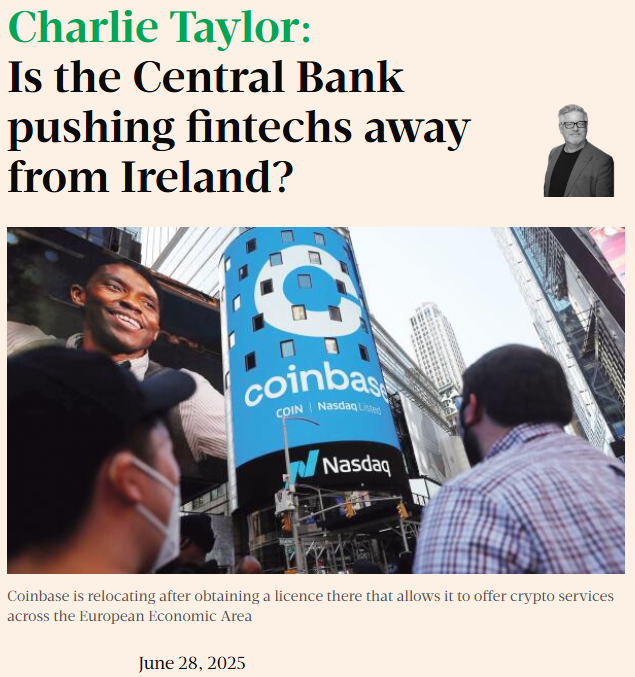 “With crypto firms able to passport their services across the EEA, there is the possibility of thousands of fintechs doing business here while being authorised elsewhere,” Non-executive director Peter Oakes, founder of Fintech Ireland and former enforcement director at the Central Bank of Ireland comments within an insightful piece by Charlie Taylor of the Business Post. In terms of optics, Coinbase’s decision to relocate doesn’t look great for Ireland Inc. But in truth, it ultimately might not matter. Peter Oakes, a former Central Bank enforcement director and founder of Fintech Ireland, an industry group, said that while many exchanges may get authorised elsewhere, there is still the potential for Ireland to become a hub for compliance and risk management. “With crypto firms able to passport their services across the EEA, there is the possibility of thousands of fintechs doing business here while being authorised elsewhere,” he said, noting that Coinbase was still keeping a big presence locally. Even so, this is a debate that is unlikely to end any time soon. Source: https://www.businesspost.ie/tech/charlie-taylor-is-the-central-bank-pushing-fintechs-away-from-ireland/ "Is certain negative narrative from 'unnamed insiders' about the Central Bank of Ireland informed, wise and indeed accurate?" Is certain negative narrative from 'unnamed insiders' about the Central Bank of Ireland informed, wise and indeed accurate?
Back to Blog
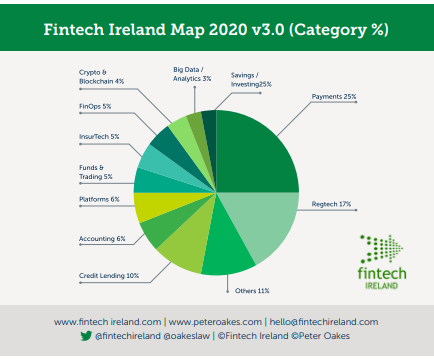
 Why would one start an article about fintech referencing Covid-19? The fact is that the virus is acting as both a headwind and tailwind for fintech companies operating from Ireland and internationally. The impact of the virus over the last month and a half on fintech has shone a spotlight on many aspects of the ecosystem that might not have otherwise come to our attention. In the current climate Ireland must also be mindful of any potential slippage of its position as a global fintech player garnered from recent years of excellent work. Let’s start with an overview of fintech. The word fintech came to prominence after the last financial crisis, particularly noticeable from 2012 onwards. Yet there were many examples of ‘financial technology’, shortened to “fintech”, existing well before the start of the last financial crisis. A number of these fintech businesses date back to the latter part of the 1980’s. Examples include the internet and phone retail bank First Direct (a division of HSBC) which kicked off in 1989 and today regularly achieves high satisfaction rates in financial surveys. Ireland too served as HQ to a pioneer challenger bank, First-e, which despite great promise was a casualty of the dot.com boom.  What does the Irish fintech scene look like? The consensus is that Ireland is home to somewhere between 220- 250 indigenous fintech companies and that together with international fintech companies in Ireland, the number is probably around 400. It is difficult to give an exact figure if only because the word “fintech” is a broad-church. The word captures, (a) the new nonbank disruptors which focus on discrete parts of the banking value chain, e.g. payments, wealth management, treasury services and credit and lending; (b) the new breed of digital only (non-branch) challenger banks entering both retail and business banking; and (c) the incumbent banks (sometimes referred to as legacy banks) embarking - with various degrees of success – on digital transformation journeys. The recent release in April of the 2020 edition of the Fintech Ireland Map4 identified 230 indigenous / Irish controlled fintech companies. This was an increase of 30% from the previous year. The Map is supported by both research and a survey. The criteria to meet to join the Map is challenging. Entrants must be fintech companies with a proprietary product or service. Broadly speaking the fintech companies operate across 12 categories, being Credit & Lending; Platforms; Funds & Trading; Crypto & Blockchain; FinOps (Financial Operations); InsurTech (Insurance Technology); Accounting; Payments; RegTech (Regulatory Technology); Savings / Investing; Big Data / Analytics; and Others. The number of firms in each category is shown in the diagram below. IF YOU LIKE WHAT YOU HAVE READ SO FAR, CONTINUE READING AT THE SOURCE (FREE - NO ADS) AT COMPLIREG
|

© Peter Oakes (all rights reserved)
There is no consent nor legitimate interest right available to data vendors (e.g Zoominfo.com) and others to use email addresses, phone numbers and address details to send unsolicited marketing communications. This notice prevents you from claiming a business-to-business avenue to send unsolicited communications to any contact details appearing on this website. The email address PETER AT PETEROAKES.COM is a personal email address and is also protected by GDPR rights.
Privacy Statement.
There is no consent nor legitimate interest right available to data vendors (e.g Zoominfo.com) and others to use email addresses, phone numbers and address details to send unsolicited marketing communications. This notice prevents you from claiming a business-to-business avenue to send unsolicited communications to any contact details appearing on this website. The email address PETER AT PETEROAKES.COM is a personal email address and is also protected by GDPR rights.
Privacy Statement.